The Tosny: Italy and Spain
The Tosny lineage belonged to the highest ranks of the Norman aristocracy at the turn of the first millennium. Documented from the beginning of the eleventh century, the Lordship of Tosny formed part of a vast territorial domain extending across the valleys of the Eure, the Seine, and the Norman Vexin, including the strongholds of Tosny, Conches, Portes, and Acquigny.
The family’s exact origins remain the subject of scholarly debate, with both Frankish and Scandinavian ancestry being proposed. Its lasting establishment in Normandy was greatly strengthened by its close ties to the Archbishopric of Rouen, particularly under Archbishop Hugh of Calvacamp († 989), who granted part of the Church’s estates to members of his own family.
Raoul de Tosny is the earliest securely documented representative of the Tosny lineage established at Tosny. Closely associated with ducal authority, he is recorded in official documents as early as 991 and played a strategic military role on the southern frontier of the Duchy of Normandy, particularly at the fortress of Tillières.
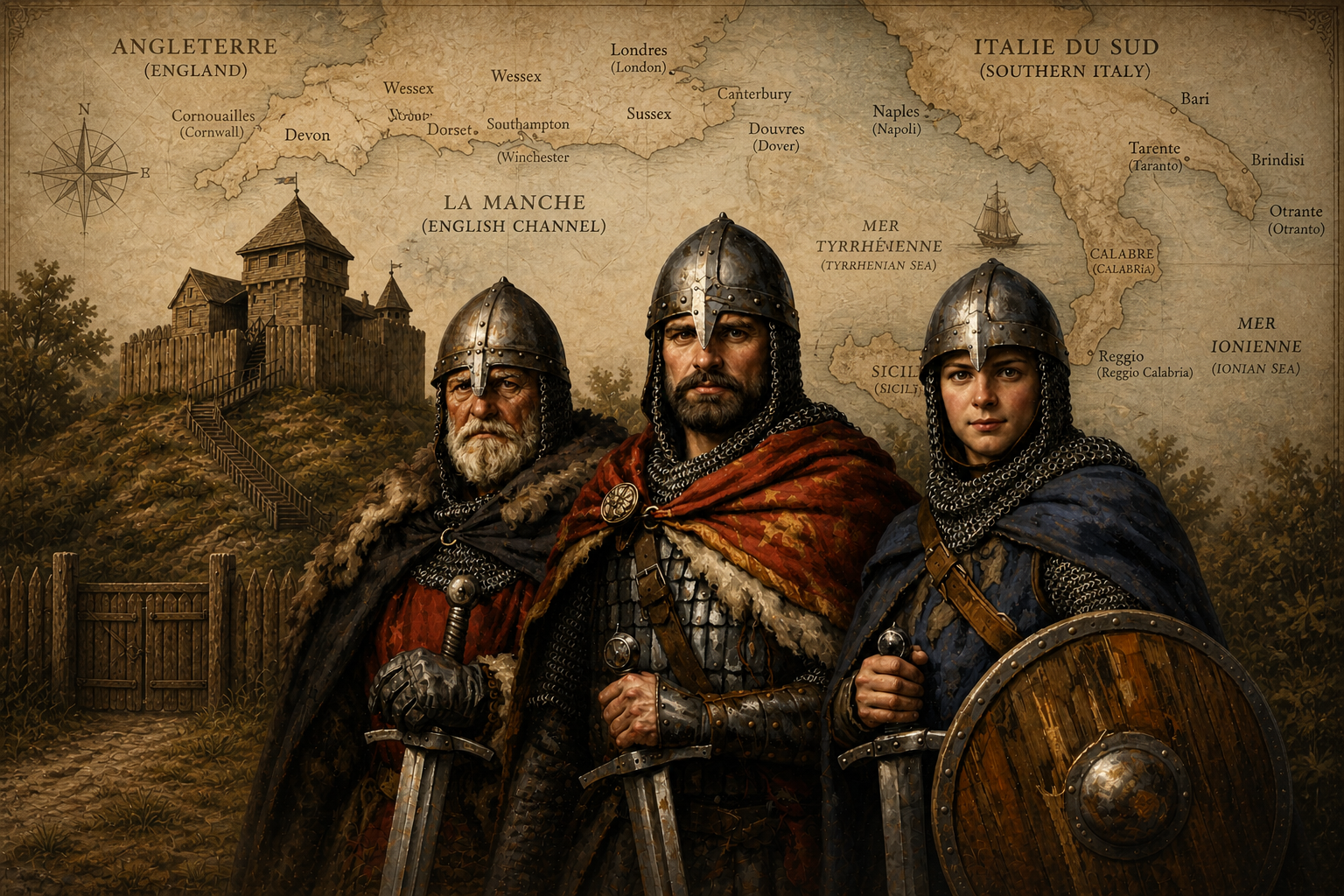
Around 1015, following a political disgrace, Raoul left Normandy and entered the service of southern Italian rulers as a mercenary. He took part in the conflicts that pitted the Lombards, the Byzantines, and imperial forces against one another in Apulia. His journey forms part of the earliest phase of Norman migration to the Mezzogiorno—a movement that was still limited in scale but would prove decisive in shaping the history of the Mediterranean during the eleventh century.
Raoul returned to Normandy before 1024 and disappears from the historical record shortly thereafter.
His son, Roger de Tosny, known as “Roger the Spaniard,” embodied the second generation of this aristocratic mobility. Following another period of exile caused by tensions with Duke Richard II, he joined the Reconquista in the service of the Christian principalities of northern Spain, where he gained a formidable martial reputation, part of which later became legendary.
Returning to Normandy during the reign of Duke Robert I, Roger consolidated his territorial power through a policy of monastic patronage. Around 1035, he founded the Abbey of Saint Peter of Castillon at Conches and made generous donations to several religious institutions in both Normandy and England, thereby strengthening both his family’s influence and its spiritual prestige.
However, the minority of William the Conqueror ushered in a new period of political instability. Refusing to recognise the authority of the young duke, Roger de Tosny became involved in a series of private wars against neighbouring lords and was killed in 1040. His two eldest sons died shortly afterwards, bringing the direct expansion of the Tosny lineage to an abrupt halt.
The history of the Tosnys illustrates the defining characteristics of the eleventh-century Norman nobility: the balance between ducal authority and seigneurial independence, the use of exile and mercenary service as means of political advancement or survival, and the central role of religious foundations in legitimising aristocratic power.
Through the Italian and Spanish careers of Raoul and Roger de Tosny, the exhibition reveals a mobile, warlike, and ambitious aristocracy, fully integrated into the wider European dynamics of the emerging feudal world.
The Tosny and England
From the mid-eleventh century onwards, the Tosny family emerged as one of the leading lineages of the Anglo-Norman aristocracy, illustrating over several generations the close ties forged between Normandy and England following the Norman Conquest of 1066. Heir to a family tradition marked by exile, military service, and seigneurial warfare, Raoul de Tosny and Conches (c. 1038–1102), the third son of Roger de Tosny, distinguished himself through his loyalty to Duke William of Normandy, becoming one of his closest barons.
A prominent military commander, Raoul played a significant role in the Franco-Angevin conflicts of the 1050s, particularly at the Battle of Mortemer (1054). Although he took part in the conquest of England, he received only modest landed rewards, scattered across several English counties. Nevertheless, he established the family’s English presence around Flamstead, while maintaining the centre of his Norman lordship at Conches. His warlike temperament led to several periods of disgrace and temporary exile, yet he remained a key figure in the baronial struggles that marked the reigns of both William the Conqueror and his sons.
By the end of the eleventh century, Raoul became deeply involved in the conflicts between William’s heirs, alternately supporting Robert Curthose and William Rufus, and later navigating the political tensions between England and Normandy. The famous “War of the Fair Ladies,” fought between the houses of Tosny and Évreux, illustrates both the violence of seigneurial rivalries and the growing independence of the great Norman barons after 1087. Raoul died in 1102, ending a long career distinguished by military achievements and generous patronage of monastic institutions.
His son, Raoul the Younger (c. 1079–1126), chose to support King Henry I Beauclerc of England, enabling him to retain the Tosny family’s English estates and secure a prestigious marriage to Adeliza of Huntingdon. He played an active role in Henry I’s reconquest of Normandy, particularly at the Battle of Tinchebray (1106). Despite occasional suspicions of duplicity during the baronial revolts, he remained loyal to the king and consolidated the family’s Norman and English possessions until his death.
Roger de Tosny (d. c. 1162–1165), who succeeded in 1126, continued the family’s tradition of military service and political pragmatism. By turns allied with the Angevins and later reconciled with King Stephen of Blois, he lived through the civil war known as the Anarchy, marked by the struggle between the Plantagenets and the supporters of the English Crown. His influence extended across both Normandy and England, where he notably founded a religious establishment at Flamstead.
Under another Roger de Tosny, a supporter first of Richard the Lionheart and later of King John, the family faced the Capetian conquest of Normandy. Their refusal to submit to Philip Augustus led, in 1203, to the permanent confiscation of the Tosny family’s Norman estates. The Honour of Conches was dismantled and redistributed among French barons, marking the family’s definitive withdrawal to England.
The following generations, represented in particular by Raoul de Tosny (†1239), became fully integrated into the English nobility. They took part in the conflicts of the Welsh Marches and participated in the Crusades. The direct male line became extinct in the early fourteenth century, with the family’s estates passing through female heirs into other prominent English aristocratic houses.
The history of the Tosnys in England thus illustrates the transformation of a Norman lineage into an Anglo-Norman family and, ultimately, into an exclusively English one. Their story reflects the major political changes that reshaped the cross-Channel world between the eleventh and thirteenth centuries: conquest, civil war, the consolidation of royal authority, and the gradual loss of their continental possessions.