
The village of Venables
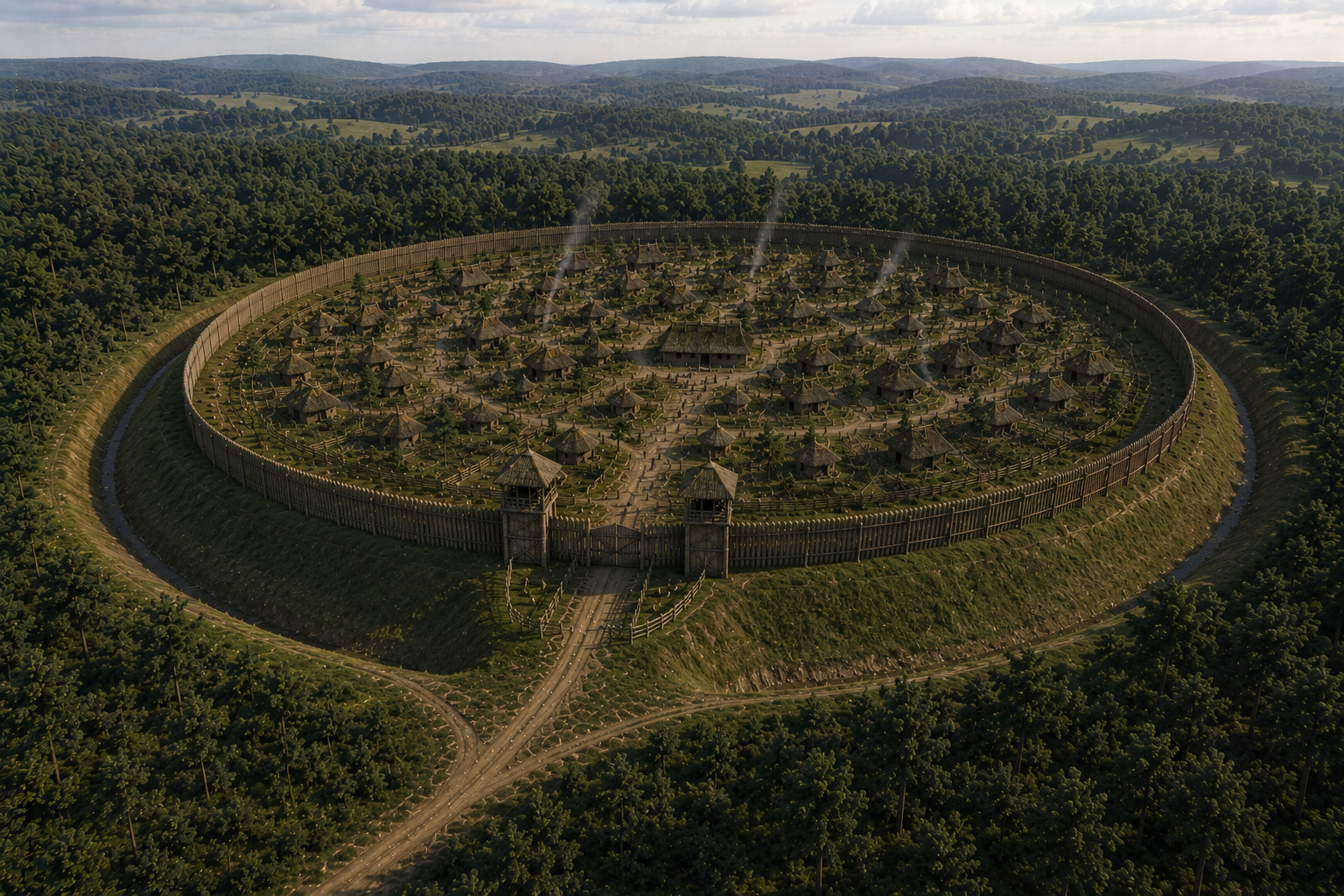
The La Tène Oppidum
On the plateau overlooking the belvedere, a fortified enclosure covering approximately 3,850 m² occupies a commanding position on the southern crest of the Val d’Ailly ravine. The site benefited from a natural spring, which continues to supply water to the valley today. Archaeological evidence suggests that this enclosure may represent a small La Tène oppidum, established by a clan of the Aulerci Eburovices.
Among the Aulerci Eburovices, the Celtic root eburo- refers to the yew tree (Taxus baccata), a species that held a central place in their cultural and symbolic world. Regarded as the Tree of Life and associated with the immortality of the soul, the yew embodied the perpetual cycle of death and rebirth through its exceptional longevity and remarkable capacity for regeneration from its roots. Although it did not represent a deity in itself, the yew symbolised the balance between the heavens, the earthly realm, and the underworld.
Beyond its symbolic significance, the yew was highly valued for its practical qualities. Its dense, reddish timber was prized for the manufacture of tools and weapons; its exceptional flexibility made it the preferred wood for bows and arrows, whose tips were sometimes coated with toxins derived from the tree’s foliage. Its fibres could also be used in the production of textiles, while its durable wood was employed in the manufacture of shields and, in particular, hunting spears (venabula).
The Evolution of the Ethnonym: Eburo- – Venabulum – Venables
During the Roman conquest of Gaul, sacred yew groves associated with Celtic religious practices were regarded with suspicion by the Roman authorities. Many of these sanctuaries were destroyed as part of the broader process of political domination, religious transformation, and cultural integration into the Roman world. The establishment of a pars urbana and a pars rustica on the lands of Venables—still known today as Les Ifs (“The Yews”)—symbolised both the Roman appropriation of the landscape and the gradual replacement of indigenous religious traditions.
The spread of the Latin language profoundly transformed local place names and cultural references. New Latin etymologies progressively supplanted earlier Celtic meanings, contributing to the disappearance of many Gallic symbolic traditions. One important exception was the hunting spear, whose symbolism endured alongside the process of Romanisation.
The Latin words venatio (“the hunt”) and venator (“hunter”) illustrate this continuity. In Roman society, and particularly in the venationes—the staged wild-beast hunts performed in the amphitheatre—the hunting spear was primarily employed as a thrusting weapon rather than as a missile. The classical Latin term for this weapon, venabulum, first appears in the writings of Cicero during the first century BC, where it denotes the hunter’s spear. In later Roman military terminology, the word also came to designate a broad-headed half-pike used in gladiatorial combat.
The poet Virgil employs the expression lato venabula ferro (“broad-bladed hunting spears”), using the plural form venabula of venabulum. Likewise, Varro writes:
Nempe feras silvaticas in montibus sectaris venabulo aut cervos.
(“Indeed, you pursue wild boars or deer through the mountains with your hunting spear.”)
By 1181, the administrative and military centre of the village appears in documentary sources under the forms Venablis and later Venabula, illustrating the gradual evolution of the place name from its Celtic origins towards its medieval Latin forms, from which the modern name Venables ultimately derives.
[1] Aulerci : « Ceux qui sont » Loin de leurs traces ou d’éloignement d’un peuple qui s’implante loin de ses origines.
[2] Eburo : désigne un arbre « l’if » ou le « sanglier » associé à l’épieu.
[3] Les sources contemporaines parmi lesquels on peut citer : Diodore de Sicile, Pomponius Mela, Lucain, Pline l’Ancien et surtout Jules César avec les Commentaires sur la Guerre des Gaules.
[4] Les Gaulois, puis Les Romains empoisonnaient leurs flèches avec. Jules César (-100 à -44) rapporte dans Commentaires sur la Guerre des Gaules (Livre V, chapitres 24 et 26, Livre VI, chapitre 31) que le roi des Éburons, Catuvolcos, s’empoisonna avec de l’if en 53 av. J.-C.
[5] Auguste Le Prévost : mémoire et notice historique et archéologique du département de l’Eure
[6] Tite-Live (trad. du latin par Annette Flobert).
[7] Gaffiot, Félix (1934) Dictionnaire illustré Latin-Français, Hachette.
Harry Thurston Peck, editor (1898) Harper’s Dictionary of Classical Antiquities, New York: Harper & Brothers.
William Smith et al., editor (1890) A Dictionary of Greek and Roman Antiquities, London: William Wayte. G. E. Marindin.
[8] Virgile : Œuvres d’Horace.
[9] Varron : écrivain et savant romain du 1er siècle av JC.
[10] Bernard Oger : Venables à travers l’histoire des origines à 1453.
Geographical location
Village coordinates: Latitude : 49°12’2.28″. Longitude :1°17’51.59″.